Child Welfare
Child Protective Services
Child Protective Services (CPS) staff investigate reports of child abuse and neglect and work with caregivers, law enforcement and judicial partners to ensure the safety of Georgia’s most vulnerable children. When an allegation of child abuse or neglect is confirmed, caseworkers partner with families and community organizations to address issues that affect child safety in the home. In most cases, DFCS can work with families to address the safety concern and stabilize the home environment.
Foster Care and Adoption Services
When children are victims of abuse or neglect, and DFCS caseworkers determine they cannot remain safely in their homes, DFCS petitions the juvenile court to bring children into foster care to ensure their safety. Foster care is intended to be a temporary solution for children as the agency works with their families to eliminate the safety issues that required DFCS intervention. DFCS’ goal is to return children safely to their families as soon as possible, but only after the safety issues have been resolved. When parents consistently demonstrate that they are unable or unwilling to care for their children, DFCS works with the courts to find loving adoptive homes for them.
In SFY 2020, the division was on track to increase adoptions as in years past, but unfortunately, the program was affected by court closures caused by the Coronavirus pandemic. However, adoption staff and the courts adjusted and leveraged technology to host virtual adoption finalization hearings. As a result, DFCS fell slightly short of its goal to increase adoption finalizations. In SFY 2020, 22% of children exited foster care through adoption. Additionally, 25% of children designated as having special needs left foster care through adoptions. The adoption unit and members from the DFCS executive team host a monthly There’s No Place Like Home call to celebrate these adoption successes.
Structured Analysis Family Evaluation (SAFE) is Consortium for Children’s standardized home study methodology that has changed the way that public and private child welfare agencies study and evaluate prospective adoptive, kin and foster families. SAFE aids home study practitioners in performing a thorough, structured and uniform evaluation of families who have applied to foster or adopt. Georgia began with a pilot of the SAFE model in late 2018, having certified 239 DFCS and Child Placing Agency (CPA) staff. In 2019, approximately 511 DFCS and CPA staff were certified, for a total of 750 SAFE certified staff members throughout the state of Georgia.
Kinship Care
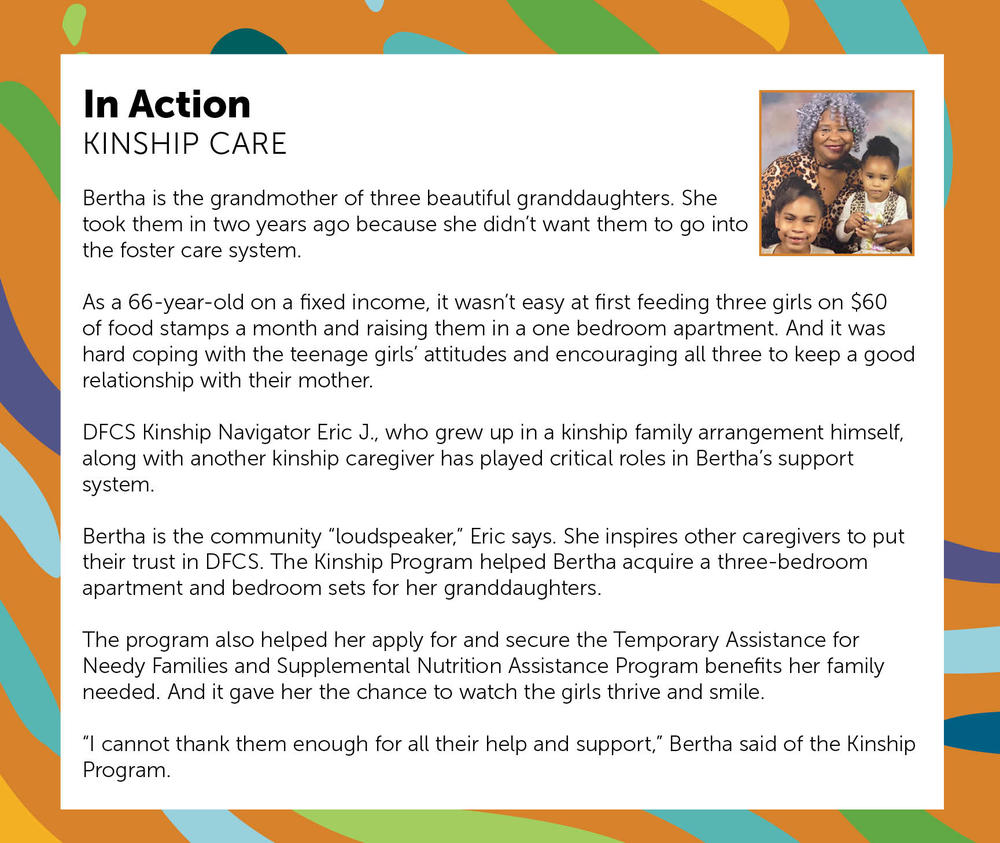
When a child is not able to safely remain in the care of their biological parents, relatives can step in to provide the stability they need during a difficult time. These arrangements are often called Kinship Care. Children who remain connected to their family, friends, school, extracurricular activities and community through these Kinship Care arrangements fare much better and experience less trauma than children placed in traditional foster care arrangements.
By the Numbers | Child Protective Services
- 34,970 reports of abuse or neglect of children were investigated by CPS staff in SFY 2020. The number of youths in foster care decreased by 16.5%
- 12 is the median number* of cases a CPS worker manages at a time
- Previously, this was reported as an average. Currently, the median figure is used, as it is less likely to be affected by extreme outlying values.
- 13,029 children were able to remain in their homes after their families received shelter, food, parenting classes or health referrals in SFY 2020
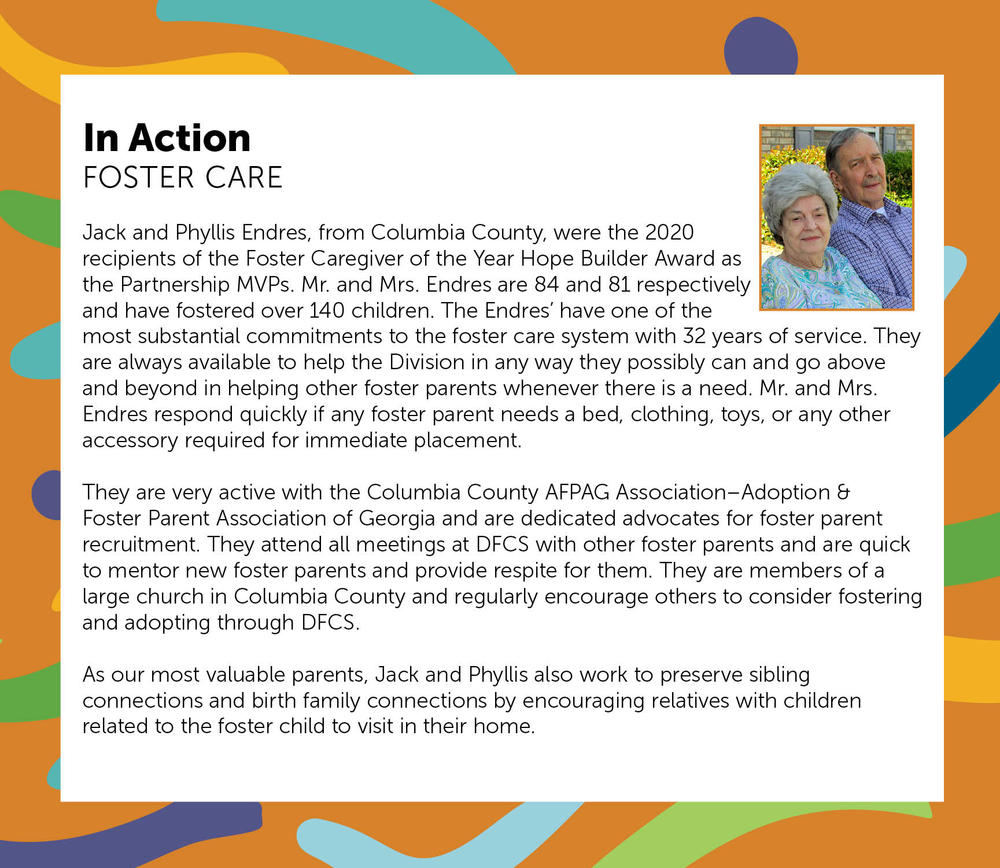
By the Numbers | Foster Care Services
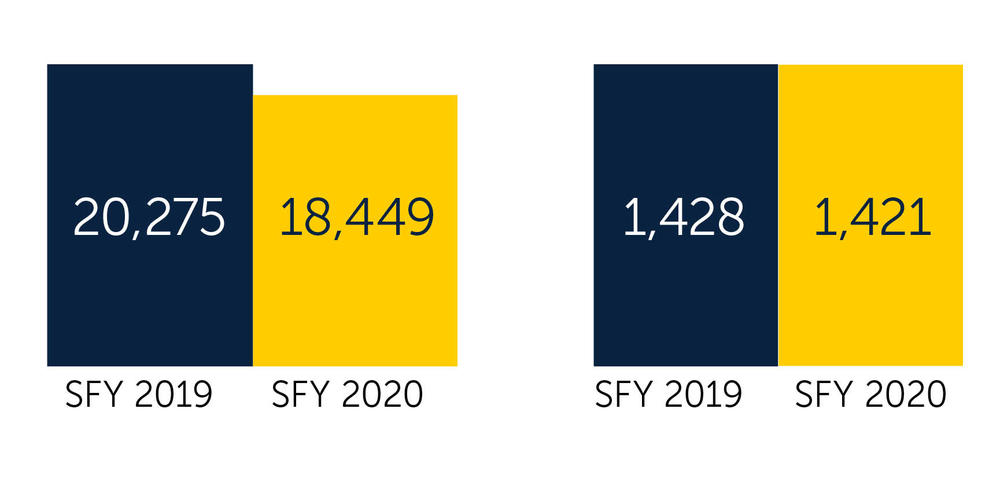
- 18,449 children were in the foster care system on average at any point in time, representing
a decrease of 10% from SFY 2019 - 1,421 children were adopted by new families and given permanent homes
- 1,647 children were in foster care at the end of SFY 2020 and were available for adoption
- 31.3% of children in foster care were placed with a relative in SFY 2020
- 20 is the median* caseload for a foster care caseworker
- *Previously, this was reported as an average. Currently, the median figure is used, as it is less likely to be affected by extreme outlying values.
- 288,297 children in Georgia live with a relative caregiver, according to grandfamilies.org
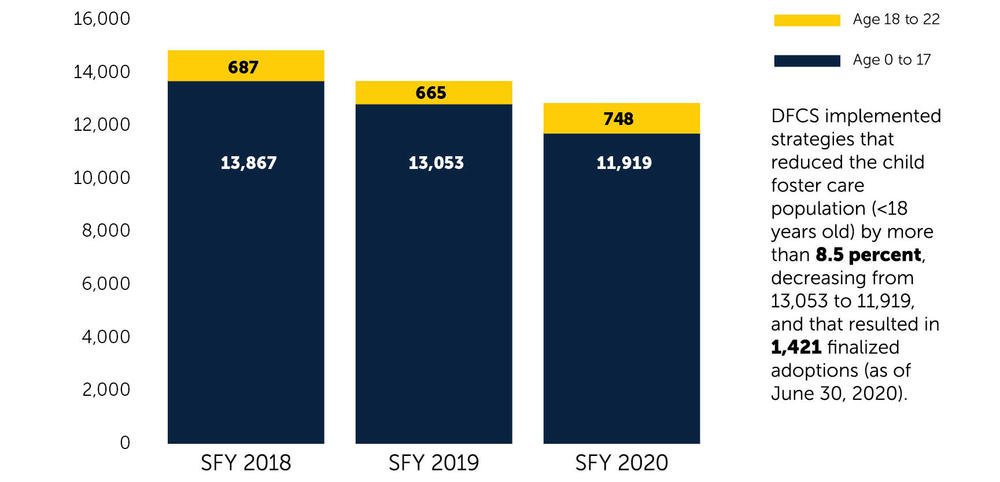
Number of children & youth in foster care*
Connected By 21
The Division of Family & Children Services bolsters children on their path to adulthood through a variety of programs that support their education, their readiness for the job market and their social well-being. The Connected by 21 program seeks to bridge the gap between adolescence and adulthood and provide youth who are aging out of foster care with the social, educational, medical and financial foundation they need to live independently as adults.
Coined the “Connections Program,” participants must meet additional participation requirements such as being employed or attending secondary or post-secondary school. Through the Connections Program, the division hopes to inspire youth to:
- Prepare for their future through educational and employment training opportunities
- Find and secure consistent and safe housing
- Build permanent connections with caring adults, including relatives, mentors and community members
- Acquire vital life skills through training and leadership opportunities to live independently
In SFY 2020, DFCS hosted three youth townhall listening sessions to solicit input from youth in foster care for the development of the Connections Extension of Foster Care program policies. The Division coordinated this effort with its program partners, the Multiagency Alliance for Children and the University of Georgia’s J.W. Fanning Institute. More than 120 youth attended these listening sessions and provided feedback on the key components of the extended foster care program, such as program eligibility, participation requirements, housing and other services. DFCS utilized this feedback to inform the policies for the Connections Extension of Foster Program. The Division will continue to support young adults in becoming more confident, productive individuals and is committed to helping them achieve lifelong success.
Since 2014, on average, 75% of the youth who turn 18 in the Georgia foster care system elect to remain in extended foster care. In 2019, 517 of the 700 youth who turned 18 decided that remaining in foster care was in their best interest.
COVID-19 support for foster youth
The Division supports an average of 350 youth each year with attending post-secondary institutions through the federal Education Training Voucher (ETV) program. Nearly one-third of those youth identified as residing in on-campus housing when campuses began to close in March 2020 due to the Coronavirus pandemic.
The Division’s Independent Living Program contacted each of the youth to determine whether they had existing support for housing, and helped those who didn’t identify available resources. The Division also provided additional stipends for ETV recipients through the remainder of the spring semester.
Georgia CREW
The Cultivating the Rising Experienced Worker (CREW) program, formerly known as the Georgia TeenWork Internship Program, has provided valuable work readiness training and youth employment experiences for older youth in care for more than 13 years.
The CREW Program serves as the youth employment hub within DFCS. The program provides a youth-friendly environment where participants can engage in a series of employment preparation services such as workshops, trainings, resource connections, hands-on work experiences and more.
By enhancing and rebranding the program, Georgia CREW will provide greater support to young people by engaging them more frequently and presenting opportunities that will help them thrive. The goals of the CREW Program are to:
- Encourage the self-sufficiency of Georgia’s foster and opportunity youth through the development of employability and work readiness skills
- Provide employability training and hands-on work experience for foster care and TANF-eligible youth who are 16 and 17 years old
- Provide employment resource connections for Georgia’s foster and opportunity youth
By the Numbers | Georgia CREW
- In Federal Fiscal Year 2020, 159 youth participated in job readiness training sessions that were taught throughout the Division’s 14 regions. Unfortunately, half of the FFY 2020 training sessions were cancelled due to the pandemic.
- 88 employers participated in the program
- 482 youth participated in the summer work programs
Afterschool Care Program
The Afterschool Care Program keeps children and youth safe when they are not in school. Additionally, afterschool programs offer tutoring services, meals, extracurricular activities and other community-based activities.
During SFY 2020, agencies funded through the Afterschool Care Program provided Science, Technology, Engineering, Arts and Math-based opportunities which allowed children to learn about 21st century career and educational pathways.
Afterschool Care Program response to COVID
Afterschool Care programs throughout the state have embraced creative methods to continuously provide services to students in their communities. All funded programs have implemented virtual learning activities as an option to keep their participants connected and engaged. Many funded partners updated their sanitation policies and practices in preparation for providing in-person programming to a reduced number of participants.
Additionally, most programs expanded their services to provide meal distribution and well-being support to help ease the burden of navigating life during the pandemic. The program’s commitment to children, families and communities helps ensure that low-to-moderate income youth in Georgia still have access to high-quality, out-of-school programming even in unprecedented times.
By the Numbers | Afterschool Care Program
- 25,903 youths were served through the Afterschool Care Program
Residential Child Care Licensing
The Department’s Residential Child Care Licensing (RCCL) unit seeks to protect children in residential care by licensing and providing oversight for a variety of child care facilities to ensure that facilities have the resources to provide for children in their care and keep them safe.
Through its Tracking Residential Applications, Incidents and Licenses System (TRAILS), RCCL also keeps stakeholders and the public informed of the quality of residential child care programs. Facilities requiring a license from RCCL include Child Caring Institutions, Child Placing Agencies, Outdoor Child Caring Programs, Children’s Transition Care Centers and Maternity Homes. Child Caring Institutions and Child Placing Agencies make up the majority of state licenses.
Child Caring Institutions (CCIs) are commonly referred to as group homes and include any institution, society, agency or facility that provides full-time care for six or more children through 18 years of age outside of their own homes. Child Placing Agencies (CPAs) are any institution, society, agency or facility which places children in foster homes for temporary care or in prospective adoptive homes for adoption. Outdoor Child Caring Programs (OCCPs) are CCIs that provide outdoor activities designed to improve the emotional and behavioral well-being of children in a wilderness or camp environment. Maternity Homes (MHs) are any place that receives, treats or cares for, within a six-month period, more than one pregnant woman whose child is born out of wedlock.
Top 5 reasons facilities received citations in SFY 2020
- Insufficient documentation of references in personnel files
- Incomplete service plans
- Insufficient or untimely health screenings of personnel
- Insufficient documentation of the involvement of the child’s guardian in the service plan
- Insufficient development, implementation and/or compliance with policies and procedures
By the Numbers | RCCL
- 321 facilities were regulated by RCCL in SFY 2020
- 9 new licenses were approved for child caring institutions
- 1 new maternity home received licensure
- 8 new licenses were approved for child placing agencies