Family Independence
Supplemental Nutrition Assistance Program
The Supplemental Nutrition Assistance Program (SNAP), formerly referred to as the Food Stamp Program, is a federally funded program that helps low-income families pay for the cost of food. The SNAP program also provides opportunities to improve their economic standing with job skills training and other support.
SNAP Works
Georgia’s SNAP Works Program is open to any food stamp recipient and offers job search, job skills training, GED programs, limited vocational training for work experience (short-term, unpaid work assignment) through partnerships with community organizations and educational institutions.
The goal of the SNAP Works Program is to help food stamp recipients who are unemployed or underemployed with job placement assistance, reducing and/or eliminating their dependency on food stamps. Training opportunities are in a variety of fields, from health care and manufacturing to teaching and welding. Able-Bodied Adults Without Dependents (ABAWDs) are required to have a job or participate in volunteer programs to keep their benefits for more than three months.
Since 2016, DFCS has expanded its partnerships with educational and technical training institutions as well as job readiness organizations to improve Georgians’ ability to get back on their feet. Through these partnerships, DFCS offers supervised job search, job skills training, GED, Second Language Acquisition (formerly referred to as English as a Second Language), vocational training for specific jobs and work experience (a short-term, unpaid work assignment). SNAP Works offers participants transportation, nutrition classes, child care, education, health classes, housing services and more.
DFCS also offers 90-day job retention services for SNAP Works participants after they have obtained employment. Job retention support services provide expenses necessary for the participant to maintain employment.
By the Numbers | SNAP
- 1,396,878 is the average number of individuals who received SNAP benefits each month
- $13,014,660 average amount of Senior SNAP benefits issued per month in SFY 2020
- 217,384 number of seniors and disabled adults who received SNAP benefits
- 29,229 SNAP recipients who participated in SNAP Works to improve their economic well-being and were not subject to ABAWD work requirements
- 88,825 number of able-bodied adults without dependents who could volunteer to participate in the program to meet federal requirements
- 135,862 number of individuals who received Senior SNAP* benefits in SFY 2020
- The Georgia Senior SNAP program is an elderly simplified application project designed to make it easier for seniors to receive food stamp benefit.
- 107,543 monthly average number of individuals who received Senior SNAP benefits
- $300 average monthly SNAP benefit per household in Federal Fiscal Year 2020 (FFY 2020)
- 902,786 children who benefited from the SNAP program in SFY 2020
- 118,054 total number of SNAP recipients served by the SNAP Works Program in FFY 2020
SNAP response to COVID-19 pandemic
In response to the coronavirus pandemic, SNAP received several policy waivers and guidance from the United States Department of Agriculture, Food and Nutrition Service, to help Georgia families meet their food and nutritional needs during the public health emergency. With these policy waivers, the SNAP program was able to:
- Simplify eligibility determinations by accepting client statements for income and certain household expenses.
- Extend certification periods for an additional six months to households beginning in March 2020.
- Suspend work requirements for ABAWDs between April and June 2020.
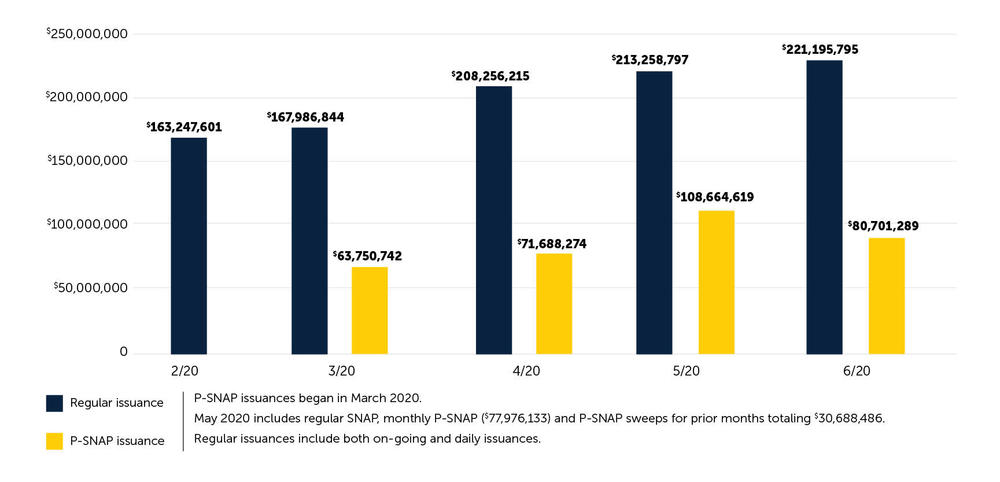
- Issue Pandemic SNAP (P-SNAP) and emergency allotments to SNAP households to bring their allotment up to the maximum benefit amount for their household size. P-SNAP and emergency allotments were issued from March through September 2020.
- Offer online EBT use with in-store pickup and grocery delivery. This expanded partnership with grocers allows SNAP recipients, especially those with underlying health conditions, to safely get food.
Temporary Assistance for Needy Families
Adults who receive Temporary Assistance for Needy Families (TANF) are required to participate in approved work activities a minimum of 30 hours each week. If the household has a child under age 6, the weekly minimum requirement is 20 hours. Children and families exhibiting the greatest need can benefit from the TANF cash assistance program if their parents participate in qualified work activities. This program is also available to children in the care of relatives. Adults who receive benefits on behalf of a relative child (called a “child-only case”) are not subject to work requirements. Activities that meet TANF work requirements include:
Unsubsidized employment
Full or part-time employment
Work experience
Work activity, performed in return for public assistance that provides an individual with the opportunity to acquire the general skills,knowledge and work habits necessary to obtain and retain employment
On-the-job training
Training given to a paid employee that provides knowledge and skills essential to the performance of the job.
Community service
Structured programs and activities for the direct benefit of the community. These programs are limited to projects that serve a useful community purpose in fields such as health, social services, environmental protection, education, urban and rural redevelopment, recreation, public facilities, public safety and/or child care
Job search and job preparedness assistance
Act of seeking or obtaining employment, or preparation to seek employment, by undergoing life skills training, substance abuse treatment, mental health treatment or other rehabilitation activities. Treatment or therapy must be deemed necessary by a qualified medical, substance abuse or mental health professional
Vocational training
Organized educational programs that are directly related to the preparation of individuals for employment in current or emerging occupations.This activity is countable for up to 12 months
Job skills training directly related to employment
Training or education required for employment to advance or adapt to the changing demands of the workplace
By the Numbers | TANF
- 12,613 total number of TANF cases in SFY 2020
- 892 average number of caregivers who receive TANF support each month and are subject to a work requirement
- $256 average benefit amount per month
- 14,519 average number of children supported by TANF each month
- 7,783 average number of child-only cases receiving TANF support each month, meaning the caregivers receive assistance on behalf of a child and are not required to participate in work activities
TANF response to COVID-19 pandemic
On March 14, 2020, Gov. Brian P. Kemp signed a Public Health State of Emergency to address the coronavirus in Georgia. That same day, TANF policy was simplified to prevent unnecessary requests of clients during the pandemic.
As a result, the number of forms with signature requirements was reduced, and TANF renewals were extended an additional six months, beginning in March and lasting through August.
Applications for TANF were available immediately via telephone, and online application submissions in Georgia Gateway were effective June 1. Mandatory work requirements were waived and work sanctions were lifted on April 1. People who wanted to participate in a supported job search activity were permitted, and they were eligible for continued work support payments once employment was obtained.
Medicaid
The Medicaid and PeachCare for Kids programs provide a safety net for children who may not otherwise have access to health care.
Family Medicaid
Low-income families with children under age 19 may qualify for Family Medicaid. These families may qualify at various income levels depending on family size and income. Families who qualify are entitled to the full range of Medicaid covered services including doctors’ visits, health checkups, immunizations, dental and vision care.
Aged, Blind and Disabled Medicaid Program
The Aged, Blind and Disabled (ABD) Medicaid Program in Georgia serves individuals who are age 65 and older, individuals who are legally blind or individuals who are disabled, as defined by the Social Security Act. There are 19 different coverage categories, known as Classes of Assistance (COA), for the ABD population. An individual’s living arrangement, income, marital status and prior Medicaid eligibility, among other factors, determine the most appropriate COA.
By the Numbers | Medicaid
- In State Fiscal Year 2020 (SFY 2020), 1,111,717 is the average number of children who received medical coverage through Medicaid each month
- 847,698 average number of families that received medical coverage through Medicaid each month
- 551,064 average number of adults who received medical coverage through Medicaid each month
- 132,342 average number of children who received medical coverage through PeachCare each month
Medicaid response to COVID-19 pandemic
On March 1, 2020, the Centers for Medicare and Medicaid Services issued several pandemic policy waivers to states for their Medicaid and Children’s Health Insurance Programs eligibility rules.
The Georgia Department of Community Health communicated those rules to DFCS for implementation for all Medicaid and PeachCare for Kids cases.
These Medicaid and PeachCare for Kids policy waivers included the following:
- Using self-attestation and client statements as acceptable verification that would normally require documents from a third party.
- Allowance to exceed timeliness standards for applications and renewals.
- Extension of period of eligibility renewal end dates. Renewals with due dates in the months of March through June 2020 were extended by six months.
- Allowing certain documents to be e-mailed as secure attachments rather than being faxed.
- Not closing or allowing benefit coverage reductions for any active Medicaid or PeachCare for Kids cases except for the reasons of death, moving out-of-state, voluntary closure and financial eligibility for Supplemental Security Income.
- Excluding pandemic stimulus payments and pandemic unemployment compensation from budget calculations.
- Suspending PeachCare for Kids premiums.
Low Income Home Energy Assistance Program
The Georgia Low Income Home Energy Assistance Program (LIHEAP) is a federally funded program that helps low-income Georgians with home energy bills to reduce the risk of health and safety issues that occur as a result of disconnection.
Qualified individuals may be able to receive energy bill payment assistance, energy crisis assistance, weatherization and energy-related minor home repairs. Applications are offered first to homebound individuals, individuals age 65 and over and those with life-threatening circumstances. For more information, call 404-657-3426 or visit dfcs.ga.gov/services/low-income-home-energy-assistance-program-liheap.
Georgia LIHEAP response to COVID-19 pandemic
Under the Coronavirus Aid, Relief, and Economic Security (CARES) Act, $900 million of supplemental LIHEAP funding will be distributed nationwide to help “prevent, prepare for, or respond to” home energy needs during the coronavirus pandemic. Georgia received more than $44 million of federal funding for LIHEAP CARES. The LIHEAP CARES Program began on July 1, 2020 in Georgia.
By the Numbers | LIHEAP
- 193,528 households received assistance from the LIHEAP program in SFY 2020
Benefit Recovery & Integrity Unit
The Benefit Integrity and Recovery Unit (BIRU) is charged with investigating recipient fraud in the agency’s public assistance programs. Examples of suspected fraud include withholding or falsifying information in order to receive public assistance to which one is not entitled, and trading or selling Electronic Benefits Transfer cards in violation of program regulations. BIRU has five operating units throughout the state:
- Benefit Trafficking
- Claims and Recoveries
- Fraud Detection and Investigations
- Investigative Analytics and
- Knowledge Management
- Staff Development
By the Numbers | BIRU
- In Federal Fiscal Year 2020, the BIRU investigated fraud claims with an established value in excess of $6,031,748
- 4,870 investigations were completed in SFY 2020
- 1,382 claims were established from the investigations in SFY 2020
- $4,364.51 average fraud claim in SFY 2020